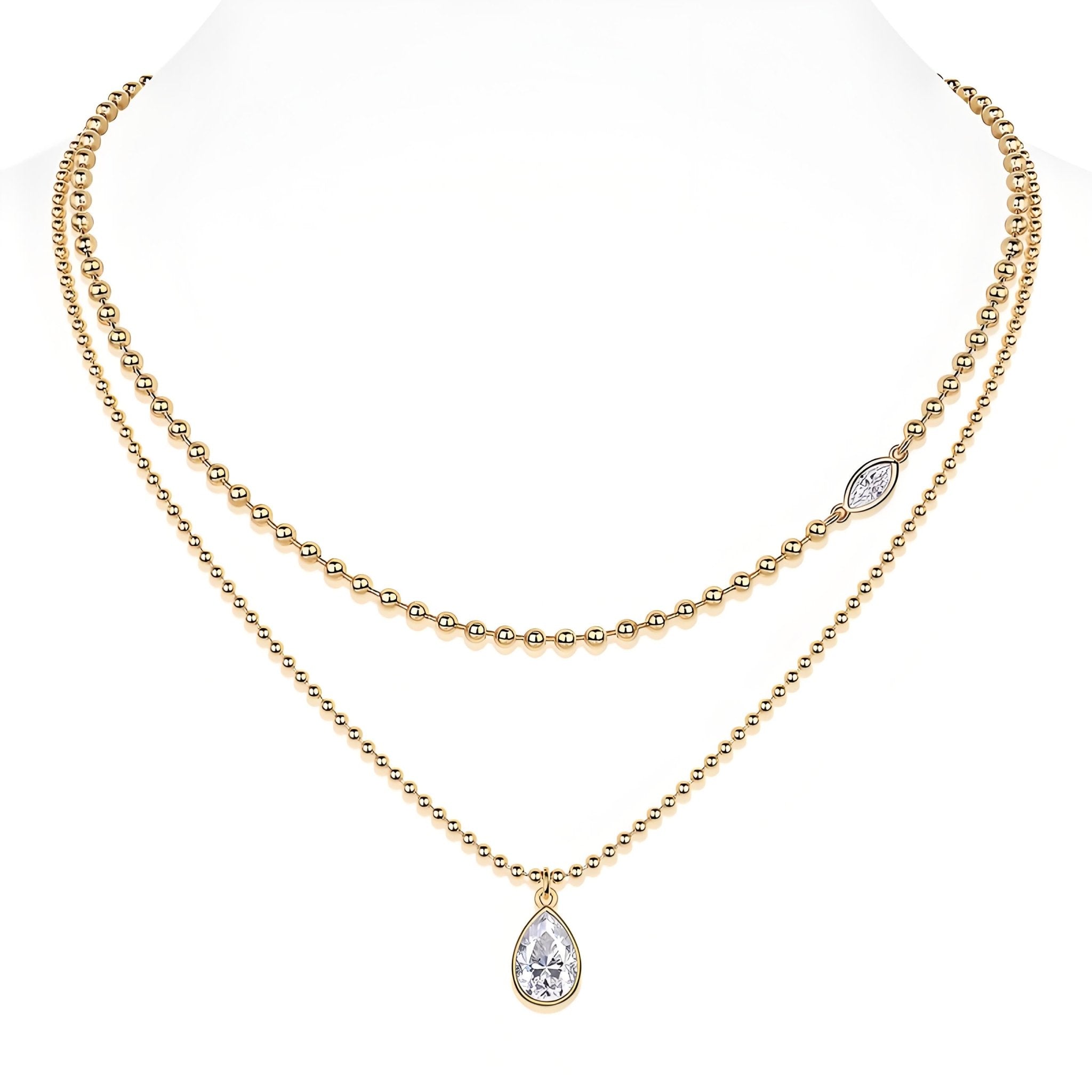

If you are shopping for an ethical engagement ring in 2026, you have likely narrowed it down to the two heavyweights: Lab-Grown Diamonds and Moissanite.
To the untrained eye, they both look like clear, sparkling stones. Both are made in a lab. Both are ethical and conflict-free.
But that is where the similarities end.
While major retailers (like Brilliant Earth) push Lab-Grown Diamonds heavily, there is a shifting trend among savvy buyers moving toward Moissanite. Why? Because when you look at the optics and the economics, Moissanite often comes out on top.
At La Pretti, we believe in getting the most sparkle for your money. Here is a breakdown of the distinct advantages of Moissanite and the honest disadvantages of Lab-Grown Diamonds that jewelers rarely talk about.
Advantages of Moissanite—It’s Not Just a Dupe
Biggest myth about Moissanite is that it’s just a diamond imitation. While, actually, it isn’t. It is a unique gemstone consist of Silicon Carbide with optical properties that actually outperform diamonds in several categories.
1. Superior Fire: Rainbow Effect
This is the showstopper.
-
Science: Gemstones are measured by their Refractive Index of how much they bend light and Dispersion of how much they split light into colors.
-
Advantage: Moissanite is 2.4 times more fiery than a diamond.
While a diamond reflects mostly white light, Moissanite acts like a prism, throwing flashes of red, orange, and blue fire across the room. Under candlelight or department store lighting, a Moissanite ring looks alive in a way a diamond does not.
2. Clarity Guarantee
Because Moissanite is synthesized from silicon and carbon in a highly controlled environment, the "quality control" is nearly perfect.
-
The Advantage: Almost all premium Moissanite found at La Pretti is graded at least VVS1 and up. You don't have to compromise and accept visible black spots /inclusions just to fit your budget, which is a common struggle when buying diamonds.
3. Unbeatable Durability For Daily Wear
Critics say, But it's not a diamond. True, but it's close.
-
Advantage: On the Mohs Scale of Hardness, a Diamond is a 10. Moissanite is a 9.25.
It is harder than sapphire, ruby, or emerald. It is extremely resistant to scratching and abrasion. Unless you plan on taking a diamond drill bit to your ring, Moissanite will last a lifetime of daily wear.

Disadvantages of Lab-Grown Diamonds for Financial Reality
Lab-Grown Diamonds are chemically real diamonds. We love them for that. However, from a financial and practical perspective in 2026, they have significant downsides.
1. Depreciation Problem
This is the elephant in the room. The price of Lab-Grown Diamonds has been plummeting for years as technology gets cheaper.
-
Disadvantage: A Lab-Grown Diamond you buy today for $2,000 might be worth $800 in three years. Unlike natural diamonds which hold some value or Moissanite which is already priced lower than them, Lab-Grown Diamonds are currently a falling knife asset. You are paying a premium for technology that is rapidly becoming cheaper.
2. Icy Look but Lack of Character
Because Lab-Grown Diamonds are created to be chemically pure, they can sometimes look... too perfect.
-
Disadvantage: Without rainbow dispersion of Moissanite, some consumers find that Lab Diamonds look steely or cold in certain lighting. If you love warm, romantic sparkles, the clinical perfection of a Lab Diamond might feel flat compared to the disco-ball effect of Moissanite.
3. Price Gap is Still Massive
Even though Lab Diamonds are cheaper than Mined Diamonds, they are still 5x to 10x more expensive than Moissanite.
-
Disadvantage: For a high-quality 2-Carat Lab Diamond, you might pay $1,500 - $2,500. For a comparable top-tier Moissanite, you will pay $500.
-
Question: Is the word Diamond on a certificate really worth an extra $2,000 if naked eyes can't tell the difference?
Comparison: The Quick Breakdown
| Feature | Lab-Grown Diamond | Moissanite | Winner |
| Sparkle Type | White Scintillation | Rainbow Fire | Moissanite (More Flash) |
| Refractive Index | 2.42 | 2.65 | Moissanite |
| Hardness (Mohs) | 10 | 9.25 | Draw (Both Excellent) |
| Price (2ct Est.) | $1,800+ | $500 | Moissanite |
| Value Stability | Dropping Rapidly | Stable / Low Entry | Moissanite |
Choose the Stone, Not the Label
If your heart is set on the chemical composition of a diamond, a Lab-Grown stone is a fantastic choice.
But if you are choosing based on beauty, budget, and brilliance, Moissanite is the clear winner. It offers more fire for a fraction of the price, allowing you to invest that extra money in a better setting, a lavish honeymoon, or your future together.
Don't settle for less sparkle.
Experience the cosmic fire of La Pretti VVS1 Moissanite collection.
💍|Shop Moissanite Engagement Rings|See The Sparkle in Video|

